

- November 13, 2026
- 04:15 PM
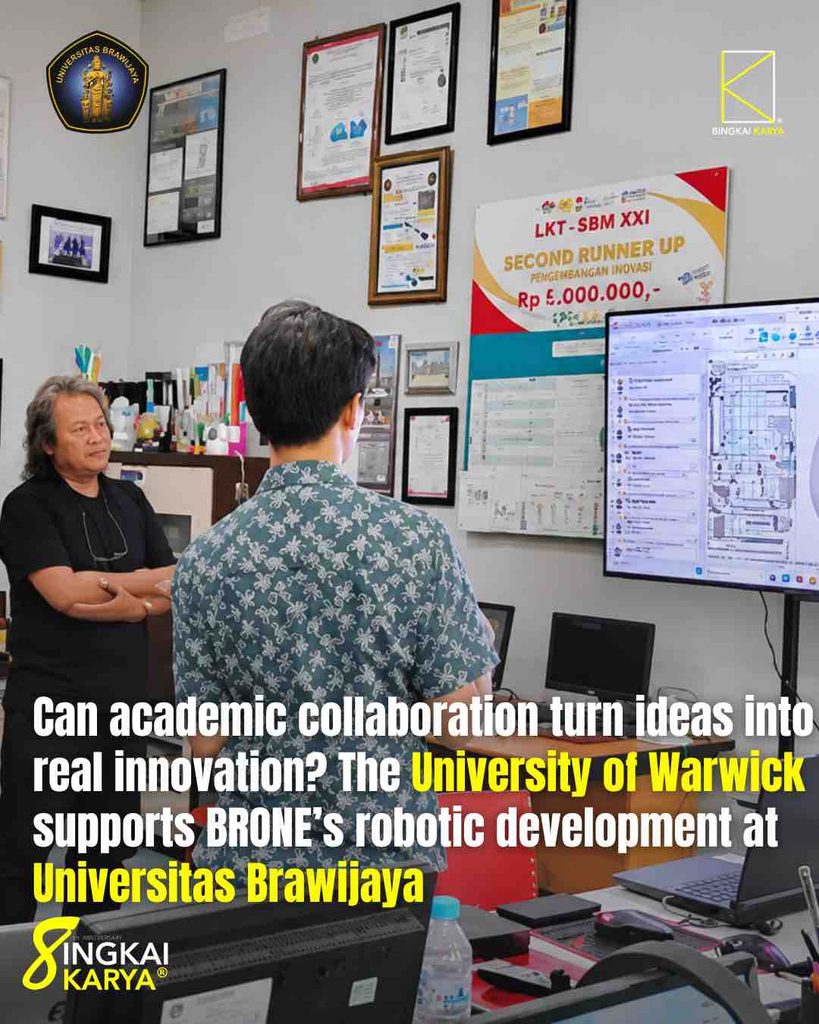
Bingkai Karya – An international academic collaboration between the University of Warwick, United Kingdom, and Universitas Brawijaya (UB), Indonesia, is supporting the development of BRONE, the university’s humanoid robot project. Through expertise in engineering design, product development, and additive manufacturing, the partnership is helping transform BRONE from a mascot concept into a physical robotic product while strengthening research networks and creating opportunities for practical engineering innovation.
The collaboration began in 2024 through an academic connection facilitated by Dr. Yudhi Ariadi of the University of Warwick and his former research supervisor, Professor Allan Rennie, from Lancaster University. Supported by the DOKAR UB 2024 funding programme, the initial initiative focused on academic exchange and research activities in additive manufacturing, engineering design, and advanced manufacturing technologies.
Dr. Ariadi subsequently visited Indonesia to deliver a guest lecture on additive manufacturing and participate in academic discussions on engineering design and product development. The engagement continued in September 2025, when the Faculty of Computer Science at Universitas Brawijaya hosted another guest lecture by Dr. Ariadi on 3D printing, alongside discussions about potential joint research in engineering design and digital manufacturing. The collaboration has also contributed to joint scholarly publications and international research outputs.
Turning a university identity into a robotic innovation
BRONE, short for Brawijaya Number One, represents Universitas Brawijaya’s identity and its values of innovation, competitiveness, and continuous learning. Its development into a physical humanoid robot aims to give the university mascot a practical technological dimension, demonstrating the institution’s capabilities in engineering, robotics, and interdisciplinary research.
Developing the robot involves more than creating its external appearance. The engineering process must address structural strength, component integration, mechanical movement, material selection, weight distribution, and manufacturing feasibility. These challenges bring together several disciplines, including mechanical design, materials engineering, computer-aided design (CAD), robotics, and manufacturing technology.
Additive manufacturing and 3D printing play an important role in translating digital designs into physical prototypes. The research explores lightweight structural concepts, including honeycomb structures, alongside material considerations and engineering evaluation. These methods support design refinement and help assess the robot’s structural performance and production requirements.
As BRONE approaches its final design stage, the team is also incorporating visual elements inspired by King Brawijaya and cultural heritage associated with the university. The approach aims to connect technological development with cultural representation while ensuring that the final design remains practical for manufacturing and assembly.
Building research capacity through collaboration
Beyond the development of the robot itself, the initiative offers opportunities for students, lecturers, and researchers to connect academic knowledge with hands-on engineering challenges. The process exposes students to problem identification, digital modelling, technical evaluation, prototyping, and iterative design improvement.
Looking ahead, the collaboration is expected to support further refinement of BRONE’s engineering design and the exploration of 3D printing-based manufacturing solutions. It also provides a foundation for future research in product development, advanced manufacturing, and robotic engineering.
Ultimately, the BRONE project demonstrates how international academic collaboration can turn engineering expertise into practical innovation, while developing research capacity and strengthening the connection between technology and institutional identity.
Read more about music here
